

Table of Contents
- What Are Clean Label Vitamins?
- Why Avoid Artificial Additives in Vitamins
- How to Read Vitamin Labels for Fillers
- Third-Party Tested Supplements: What It Means
- Synthetic vs Natural Vitamins: Key Differences
- Top Clean Label Vitamin Brands for 2026
- Understanding Supplement Certifications and Testing
- Choosing the Right Clean Label Vitamin for Your Needs
Last Updated: August 11, 2026
What Are Clean Label Vitamins?
Clean label vitamins contain only essential nutrients without artificial additives, synthetic fillers, or unnecessary ingredients. They list recognizable components, avoid synthetic additives, and often include third-party testing to verify label accuracy. At Green Organic Supplements, we prioritize ingredient transparency and purity, ensuring you know exactly what you're consuming. This shift reflects consumer demand for simplicity over unpronounceable chemicals, recognizing that your body processes supplements more effectively without fillers and binders designed solely for shelf appearance or manufacturing convenience.
Why Avoid Artificial Additives in Vitamins
Artificial additives serve manufacturers, not your health. Synthetic colorings, preservatives like BHA and BHT, and unnecessary binders extend shelf life and reduce production costs without nutritional benefit. Your digestive system must process these compounds, which can trigger sensitivity reactions including bloating, nausea, or constipation, the very symptoms you're trying to address.
Common artificial additives include titanium dioxide (for whiteness), artificial dyes, and synthetic preservatives. Research on long-term effects of many synthetic additives remains incomplete. Rather than waiting for definitive studies, health-conscious consumers choose to avoid them entirely. Beyond personal health, artificial additives raise environmental concerns; manufacturing synthetic compounds consumes energy and generates waste.
How to Read Vitamin Labels for Fillers
The "other ingredients" section reveals where manufacturers hide fillers and binders. If you see more than 3-4 items there, the product likely contains unnecessary additives. Compare against clean label standards: Green Organic Supplements keeps "other ingredients" to essential items only, typically just capsule material.
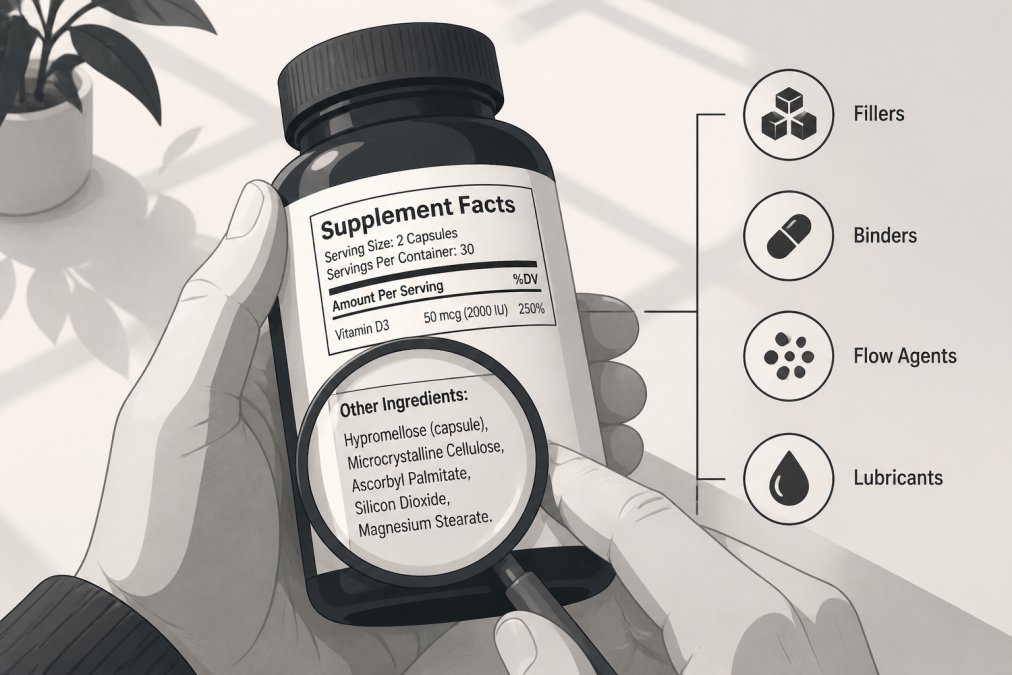
Common Fillers and Binders to Watch For
Maltodextrin appears as a flow agent derived from corn, rice, or potato starch, serving no nutritional purpose. For people with corn sensitivities, this becomes problematic.
Microcrystalline cellulose is processed plant fiber used as a bulking agent and binder. While technically "natural," it's heavily processed and can contribute to digestive discomfort in large quantities.
Magnesium stearate is a lubricant that prevents ingredients from sticking to equipment. Some research suggests it may impair nutrient absorption, making it worth avoiding when cleaner options exist.
Titanium dioxide provides whiteness but serves purely cosmetic purposes. Some research raises safety questions in high doses.
Artificial colorings (FD&C dyes) add visual appeal with zero nutritional value. Red 40, Yellow 5, and Blue 1 can trigger sensitivities.
Silicon dioxide functions as an anti-caking agent, existing solely for manufacturing convenience rather than health benefit.
Decoding the Supplement Facts Panel
The Supplement Facts panel lists nutrient amounts and Daily Value percentages, but the form matters significantly for absorption. Vitamin D3 (cholecalciferol) is more bioavailable than D2; methylcobalamin (B12) absorbs better than cyanocobalamin. High-quality clean label vitamins specify these forms.
Check the "amount per serving" carefully. Some multivitamins list nutrients below the Daily Value, adequate for general wellness but insufficient for addressing deficiencies. Look for notation of ingredient sourcing, whether B vitamins derive from natural fermentation or synthetic production, whether vitamin E comes from mixed tocopherols or d-alpha tocopherol alone.
Third-Party Tested Supplements: What It Means
Third-party testing verifies that labels accurately reflect contents, no banned substances are present, and no heavy metals or contaminants contaminate the product. This matters because the supplement industry operates under less stringent FDA oversight than pharmaceuticals.
Common certifications include NSF Certified for Sport (verifies no banned athletic substances and tests for heavy metals), USP Verified (ensures ingredient identity, purity, potency, and disintegration), and ConsumerLab testing (independently verifies formula accuracy). When you see a "third-party tested" claim, ask which organization performed the testing. Reputable certifications appear on the label or manufacturer's website with specific documentation.
Heavy metals testing is particularly important for plant or mineral-sourced supplements. Lead, cadmium, arsenic, and mercury bio-accumulate in certain plants grown in contaminated soil. Third-party testing screens for these contaminants at safe levels. Green Organic Supplements invests in this testing because our hand-made formulations source from specific suppliers where traceability matters.
Synthetic vs Natural Vitamins: Key Differences
The chemical structure of synthetic vitamin C is identical to one extracted from an orange; your body processes them the same way at the molecular level. The distinction lies in bioavailability and what accompanies the nutrient. Natural vitamin E exists as mixed tocopherols; synthetic versions isolate d-alpha tocopherol. Your body recognizes and utilizes mixed tocopherols more efficiently. Natural B vitamins derived through fermentation often include cofactors that enhance absorption.
Natural sources also avoid manufacturing byproducts inherent in synthetic production. Synthetic vitamins are created through chemical processes that can leave residual solvents; natural extraction typically involves fewer synthetic intermediates. The cost difference is real: synthetic vitamins cost less to produce, while natural or naturally-derived vitamins require more sophisticated sourcing, reflecting in higher prices.
Bioavailability and Absorption
Bioavailability measures how much of a nutrient your body actually absorbs and utilizes. Several factors affect it: the nutrient form (chelated minerals absorb better than mineral salts), dietary fat (required for fat-soluble vitamins A, D, E, K), and meal timing (water-soluble vitamins absorb better on empty stomachs but are less sensitive to timing).
Fillers and binders can impair bioavailability. When a tablet is packed densely with binding agents, your digestive system struggles to break it apart efficiently. Clean label formulations, by eliminating unnecessary binders, often show better absorption rates. Individual factors also influence bioavailability: age, digestive health, medications, and genetic variations in nutrient metabolism.
Top Clean Label Vitamin Brands for 2026
Green Organic Supplements: Hand-Made USA Formulas
Green Organic Supplements stands out for hand-made formulations crafted in the USA with clean ingredients prioritizing your health without compromise. Every formula focuses on ingredient integrity, no synthetic fillers, no artificial additives, no unnecessary binders obscuring what you're taking.
Hand-made production allows meticulous quality control at every stage. Rather than mass-producing standardized formulas, Green Organic Supplements tailors batches to ensure consistency and purity. Fresh delivery means your vitamins reach you at peak potency. Transparency about sourcing lets you trace ingredients back to specific suppliers where quality assurance and traceability form the foundation. For sensitive digestive systems, clean formulations eliminate fillers and binders that trigger nausea or constipation in other brands.
Pure Encapsulations O.N.E. Multivitamin
Pure Encapsulations O.N.E. delivers comprehensive nutritional support in a hypoallergenic capsule free from added coatings, binders, shellacs, artificial flavors, sweeteners, or colors. The formula includes Metafolin L-5-MTHF (a bioavailable form of folate) and CoQ10 for cellular energy production.
This brand prioritizes people with multiple sensitivities. The hypoallergenic designation means it's formulated without wheat, gluten, nuts, eggs, preservatives, or hydrogenated oils. For someone with a sensitive digestive system who's tried multiple brands and experienced reactions, Pure Encapsulations' clean label approach often resolves those issues.
Thorne Basic Nutrients 2/Day
Thorne Basic Nutrients 2/Day provides foundational nutritional support in two capsules daily using pure and absorbable forms of vitamins and minerals. NSF Certified for Sport designation means the formula has been tested for purity and absence of banned substances, important for active individuals and those prioritizing quality assurance.
This brand appeals to people seeking a high-quality foundational multivitamin without excessive potencies or unnecessary additions. The clean label approach means you're not paying for fillers; you're investing in nutrient forms your body actually absorbs.
Ritual Essential for Women 18+
Ritual Essential for Women 18+ targets nutrient gaps common in women's diets with nine key vitamins and minerals in a vegan, sugar-free formula. The brand emphasizes transparency through ingredient traceability; you can see where each nutrient comes from. USP Verified and Non-GMO Project Verified certifications back the quality claims.
The subscription model ensures consistent delivery without reordering hassle. The limitation is scope: nine nutrients provide foundational support but may not address specific deficiencies or comprehensive nutrient profiles some people need.
MegaFood One Daily Multivitamin
MegaFood One Daily delivers vitamins and minerals alongside real food ingredients like carrots and organic orange. The single-daily format appeals to people seeking convenience. The formula is glyphosate residue free and free from nine common allergens. The food-based approach resonates with those who believe nutrient delivery in a food context enhances absorption.
Understanding Supplement Certifications and Testing
NSF Certified for Sport tests for banned substances, heavy metals, and contaminants, appealing to athletes and those wanting assurance of no unexpected compounds.
USP Verified confirms that supplements contain listed ingredients at stated potencies and will disintegrate properly for absorption. It's one of the most comprehensive third-party certifications available.
Non-GMO Project Verified confirms ingredients are not genetically modified, providing assurance for those concerned about GMO sourcing.
USDA Certified Organic indicates ingredients meet federal organic standards with no synthetic pesticides, fertilizers, or GMOs in crop production.
ConsumerLab conducts independent testing, verifying products contain what they claim and are free from contaminants. Their testing reports are publicly available.
The absence of certification doesn't automatically mean a product is inferior; some smaller brands with rigorous quality control skip third-party testing due to cost. But for clean label vitamins, third-party testing provides objective verification that manufacturer claims are accurate.
Choosing the Right Clean Label Vitamin for Your Needs
For Sensitive Digestive Systems
People with sensitive digestive systems need clean label vitamins formulated for easy breakdown. Fillers like microcrystalline cellulose and magnesium stearate often trigger bloating, nausea, or constipation. Eliminating these compounds frequently resolves digestive upset that made other supplements intolerable.
Look for formulations with minimal "other ingredients," ideally just capsule material. Capsule forms generally disintegrate more easily than tablets. Avoid formulations with added magnesium stearate; some manufacturers use alternative lubricants or optimize production to eliminate the need entirely. Taking vitamins with food increases absorption and reduces nausea, though it may slightly decrease bioavailability for some nutrients.
For Chronic Health Management
People managing chronic conditions often take multiple medications that interact with nutrients. A clean label vitamin formulated without unnecessary additives reduces the risk of unexpected interactions or sensitivities.
If managing inflammation, arthritis, or cardiovascular conditions, look for formulations that include targeted nutrients: omega-3s, curcumin, CoQ10, or magnesium depending on your condition. Consistency matters for chronic health management; you need vitamins you can take reliably every day without side effects. Green Organic Supplements' fast delivery and fresh product approach ensures you're not taking vitamins that have degraded in storage.
For Active Lifestyles
Active individuals have elevated nutrient needs for muscle recovery, energy production, and immune support. NSF Certified for Sport multivitamins provide assurance that the formula contains no banned substances, important for competitive athletes.
Look for formulations that include adequate B vitamins for energy metabolism, magnesium for muscle function, and antioxidants for recovery. Clean label formulations designed for easy absorption work well regardless of timing strategy.
Selecting clean label vitamins without additives is fundamentally about taking control of what enters your body. Rather than accepting fillers and synthetic additives designed for manufacturing convenience, you're choosing formulations built around your health needs. Green Organic Supplements' hand-made, USA-crafted approach to clean label vitamins reflects this philosophy: every ingredient serves your wellness, nothing more. Shop All to explore formulations matched to your specific health situation and experience the difference that true ingredient integrity makes.
Frequently Asked Questions
How can I tell if a vitamin is truly clean label?
Check the ingredient list for unnecessary fillers, binders, artificial colorings, and preservatives. Look for third-party testing certifications like NSF Certified for Sport or USP Verified on the label. Verify that the supplement contains only the active nutrients listed on the Supplement Facts panel, with minimal inactive ingredients. Transparent brands provide ingredient sourcing information and traceability details, which you can often find on their website or by contacting customer service.
What's the difference between third-party tested supplements and others?
Third-party tested supplements are independently verified by organizations outside the manufacturer to confirm purity, potency, and absence of contaminants like heavy metals and pesticide residues. This testing ensures label accuracy and identifies any harmful substances. Non-tested supplements rely solely on the manufacturer's quality control, which may not catch contaminants or verify that ingredients match label claims. Third-party certification provides measurable assurance of product safety and integrity.
Are natural vitamins better than synthetic ones?
Natural vitamins are derived from food sources and often have better bioavailability, meaning your body absorbs them more efficiently. Synthetic vitamins are chemically created in a lab and may be absorbed differently. However, quality matters more than the source: a well-formulated synthetic vitamin can outperform a poorly made natural one. Look for vitamins that use bioavailable forms of nutrients, minimal fillers, and third-party testing regardless of whether they're natural or synthetic.
Can I take clean label vitamins with my prescription medications?
Clean label vitamins are generally safer due to fewer additives and fillers, but you should consult your healthcare provider before adding any supplement to your routine, especially if you're on prescription medications. Some nutrients can interact with certain medications or affect their absorption. Your doctor can review your specific medications and recommend appropriate supplementation without risking conflicts or complications.
This article was written using GrandRanker